Introduction
The internet has become an essential part of everyday life. People use it to communicate, shop, manage finances, and store personal information, while businesses rely on digital platforms to manage operations and serve customers. However, behind these everyday activities exists a hidden side of the internet where stolen information, compromised accounts, and illegal services can be traded with relative anonymity.
This part of the digital world is commonly associated with the dark web. Although the dark web has legitimate uses, including privacy protection and secure communication, it has also become a marketplace for cybercriminals who buy and sell stolen data, exchange hacking tools, and organize fraudulent activities.
Stolen information has become one of the most valuable resources in modern cybercrime. A single compromised account may provide access to private messages, financial details, or business systems. When large databases are exposed, the information can be reused for identity theft, financial fraud, phishing campaigns, and other malicious activities.
What makes this problem especially concerning is that a data breach does not always end when the original security incident is resolved. Stolen information may continue circulating for months or even years, creating new risks for individuals and organizations.
Understanding the dark web threat landscape is therefore an important part of modern cybersecurity. By learning how stolen data is traded, how criminals use it, and how to reduce exposure, people and businesses can take meaningful steps toward protecting their digital identities.
What Is the Dark Web?
The dark web refers to websites and online services that are intentionally hidden from ordinary browsing and generally require specialized software or configurations to access.
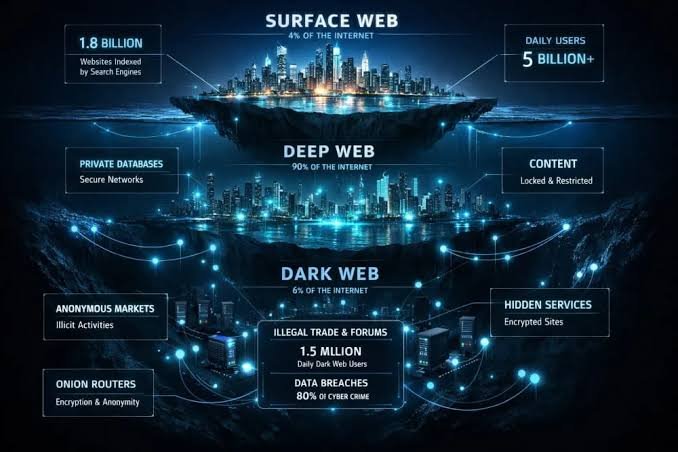
It is important to distinguish the dark web from the deep web.
The surface web includes publicly accessible websites that can generally be found through standard search engines, such as news websites, blogs, and public business pages.
The deep web includes online content that is not publicly indexed, such as private email accounts, subscription databases, online banking portals, and internal company systems.
The dark web is a smaller part of the broader internet that uses technologies designed to conceal the location of services or provide additional anonymity.
The dark web is not inherently illegal. Journalists, researchers, whistleblowers, and people living under restrictive governments may use privacy-focused services for legitimate reasons. However, certain hidden services are also used for illegal activities, including selling stolen information, distributing malware, and coordinating fraud.
For cybersecurity professionals, the important issue is not simply whether information appears on the dark web. It is understanding whether that information has been exposed, who may be affected, and what actions can reduce the resulting risk.
Why Stolen Data Is Valuable to Cybercriminals
Personal and business information has significant value because it can be used to impersonate people, gain access to accounts, or manipulate victims into making financial decisions.
Cybercriminals may collect information through phishing attacks, malware infections, compromised websites, insecure databases, or stolen employee credentials.
Once obtained, the information can be sold, shared, or reused in other criminal activities.
Different types of stolen data can serve different purposes.
1. Personal Information
Names, addresses, phone numbers, dates of birth, and other personal details can help criminals construct believable identities.
This information may be used in identity theft, fraudulent account applications, targeted scams, or attempts to bypass weak identity verification procedures.
Even information that appears harmless on its own can become more dangerous when combined with other exposed records.
For example, a criminal who knows someone’s name, employer, and phone number may be able to create a convincing message pretending to be a colleague or service provider.
2. Login Credentials
Usernames and passwords are among the most frequently targeted forms of digital information.
Criminals may obtain credentials through phishing, malware, data breaches, or attacks against poorly protected systems. They may then attempt to use the stolen credentials to access email accounts, shopping platforms, cloud services, or business applications.
Password reuse makes this problem more serious. If a person uses the same password across several websites, a breach affecting one service may create risks for multiple accounts.
Compromised email accounts can be particularly valuable because they may contain password-reset messages, financial correspondence, confidential documents, and access to other services.
3. Financial Information
Payment card details, banking information, and financial account credentials can be used to support fraud and unauthorized transactions.
Depending on the information exposed and the security controls protecting the account, criminals may attempt unauthorized purchases, fraudulent transfers, or other forms of financial abuse.
Financial institutions often have systems for detecting suspicious transactions, but victims may still experience disruption, temporary loss of access to funds, or lengthy account recovery procedures.
Promptly reporting suspicious activity can improve the chances of limiting further damage.
4. Corporate Data
Businesses may store confidential information about customers, employees, suppliers, products, and internal operations.
When this information is stolen, criminals may use it to demand ransom, conduct corporate espionage, impersonate employees, or target business partners.
Sensitive corporate records can also reveal how an organization operates, which systems it uses, and who has authority to approve payments or access important resources.
This makes stolen business information valuable beyond its immediate contents.
5. Authentication Tokens and Session Data
Some attacks target information that allows a user to remain signed in to an application or service.
If an attacker obtains a valid session token or other authentication material, the attacker may be able to access an account without relying solely on a stolen password.
This is one reason why organizations must protect active sessions, monitor unusual account behavior, and revoke compromised sessions quickly.
Strong authentication remains essential, but businesses should also consider how they detect and respond to suspicious activity after a user has successfully signed in.
How Stolen Data Reaches the Dark Web
Stolen information can enter criminal marketplaces through several different pathways. In many cases, the dark web is only one part of a much larger process involving data theft, resale, and repeated misuse.
1. Data Breaches
A data breach occurs when sensitive information is accessed, disclosed, altered, or stolen without authorization.
Breaches may result from software vulnerabilities, compromised credentials, misconfigured cloud storage, insider threats, or other security failures.
After a breach, criminals may attempt to sell the exposed records or use them in further attacks.
Large databases can attract particular attention because they may contain information about thousands or millions of people. However, even a small breach can create serious consequences when the exposed information provides access to a sensitive account.
2. Phishing Attacks
Phishing involves tricking victims into revealing information or performing actions that benefit an attacker.
A fraudulent email may imitate a bank, employer, delivery company, or online service and ask the recipient to verify account details. A convincing fake login page may then capture the victim’s credentials.
The stolen information can be used immediately or passed to other criminals.
Modern phishing attacks may also use AI-generated messages, realistic impersonation, and information collected from social media to make fraudulent requests more convincing.
People should therefore verify unexpected requests rather than relying only on spelling mistakes or suspicious-looking messages to identify scams.
3. Infostealer Malware
Infostealer malware is designed to collect information from infected devices. Depending on the malware and the permissions it obtains, it may target saved passwords, browser data, session information, and other sensitive material.
If a device is compromised, the collected information may be transferred to criminals, who may subsequently distribute or sell it.
An infection can therefore create risks that extend beyond the original device. For example, stolen credentials may expose accounts that the victim accesses from other computers or mobile devices.
Keeping software updated, avoiding untrusted downloads, and using reputable security tools can help reduce the likelihood of infection.
4. Compromised Business Systems
Attackers may gain access to business networks through vulnerable applications, stolen employee credentials, insecure remote access, or compromised suppliers.
Once inside, they may search for customer databases, financial documents, intellectual property, or other valuable information.
The stolen data may later be offered for sale or used as leverage in a ransomware extortion attempt.
Businesses can reduce these risks through network segmentation, least-privilege access, continuous monitoring, and regular security assessments.
5. Insider Threats
Not every data theft originates from an external hacker.
An employee, contractor, or other authorized user may intentionally steal information or accidentally expose it through unsafe practices.
Insider-related incidents can be difficult to identify because the individual may already have legitimate access to the information involved.
Organizations should restrict access to sensitive data, monitor unusual downloads, review permissions regularly, and establish clear procedures for handling confidential information.
How Criminals Use Stolen Data to Fuel Cybercrime
The theft of information is often only the beginning. Criminals may reuse the same records in multiple schemes, creating a chain of fraudulent activity that can continue long after the original breach.
1. Identity Theft
Identity theft occurs when someone uses another person’s personal information without permission, often for financial gain.
Stolen personal records may be used to impersonate victims, attempt fraudulent applications, or support scams involving banks and other institutions.
The consequences can include financial losses, damaged credit records, and lengthy efforts to restore control over affected accounts.
Victims may also face repeated attempts at fraud because their information can remain available to criminals after the original incident.
2. Account Takeover
Account takeover occurs when a criminal gains unauthorized control of an existing account.
Stolen passwords, authentication information, or session data may allow attackers to access email, social media, online banking, or business services.
Once an account is compromised, the attacker may change recovery details, send fraudulent messages, steal information, or attempt to compromise other accounts.
Email accounts are particularly important because they are often used to reset passwords for other services.
Using unique passwords, enabling multifactor authentication, and securing account recovery options can reduce the risk.
3. Ransomware and Data Extortion
Ransomware attacks may involve encrypting files or disrupting systems to prevent normal operations.
Some criminal groups also steal sensitive information and threaten to publish it unless the victim pays a ransom. This is commonly described as data extortion.
Stolen information may therefore become a source of leverage, even if the organization has backups that allow it to restore its systems.
Businesses should protect sensitive data, restrict access, maintain isolated backups, and prepare incident response procedures that address both system disruption and potential data exposure.
Paying a ransom does not guarantee that stolen information will be deleted or that criminals will stop using it.
4. Targeted Phishing and Social Engineering
Stolen information can help criminals create more convincing scams.
For example, an attacker who obtains employee names, job titles, supplier details, or internal business correspondence may use those details to impersonate a trusted colleague.
A fraudulent payment request may appear more believable if it refers to a real project or uses the correct names of people involved.
This is why data breaches can increase the effectiveness of later attacks. Information that was originally stolen for one purpose may become useful in many different scams.
5. Corporate Espionage and Intellectual Property Theft
Some attackers target trade secrets, research documents, product designs, strategic plans, and other confidential business information.
Such material may provide competitors or criminal organizations with valuable insights into an organization’s operations and future plans.
The exposure of intellectual property can affect a company’s competitive position and lead to significant financial losses.
Businesses should classify sensitive information, restrict access to employees who need it, and monitor unusual data transfers.
6. Fraud Against Customers and Business Partners
When criminals obtain customer records or supplier information, they may use that knowledge to target people connected to the affected organization.
A customer might receive a fraudulent message that references a recent transaction. A supplier might receive an invoice that appears to reflect a legitimate business relationship.
These attacks can be especially effective because the criminals may know details that make their messages appear authentic.
Organizations should notify affected parties when appropriate and provide clear guidance about suspicious messages and verification procedures.
Why Dark Web Threats Are Difficult to Control
The dark web threat landscape presents several challenges for cybersecurity professionals, businesses, and law enforcement agencies.
Anonymity and Hidden Services
Privacy-focused technologies can make it more difficult to identify the people operating certain online services. Criminals may also use multiple accounts and intermediaries to conceal their activities.
However, anonymity is not absolute, and law enforcement agencies have successfully investigated and disrupted criminal operations.
Rapid Distribution of Stolen Information
Once information has been copied and shared, removing the original source does not guarantee that every copy will disappear.
Data may be redistributed, combined with other records, or used in new attacks. This makes it difficult to fully reverse the consequences of a breach.
International Criminal Networks
Cybercrime frequently crosses national borders. The victim, compromised service, criminal operator, and data storage location may all be in different countries.
Investigations can therefore require cooperation between law enforcement agencies, technology providers, financial institutions, and cybersecurity specialists.
Constantly Changing Criminal Methods
Criminal marketplaces and groups may change their methods in response to security improvements, law enforcement actions, and changes in technology.
Defenders must continually review threat intelligence and update their security practices.
This does not mean every new threat requires a new product. Often, strong identity controls, timely patching, reliable backups, and careful access management remain among the most effective defenses.
How to Protect Yourself From Dark Web Data Threats
Individuals cannot control every organization that stores their information, but they can take practical steps to reduce the likelihood and impact of identity theft.
1. Use Unique Passwords for Every Account
Reusing passwords creates a serious risk because a breach affecting one service can expose other accounts.
Use a reputable password manager to generate and store strong, unique passwords. This makes it easier to protect multiple accounts without remembering every password.
If you learn that a service you use has experienced a breach, change the affected password and any other password that reused the same credentials.
2. Enable Multifactor Authentication
Multifactor authentication requires an additional verification step beyond a password.
Enable it for email, banking, cloud storage, social media, and other important accounts.
Where available, consider passkeys or phishing-resistant security keys for stronger protection against credential theft.
Remember that MFA is not a guarantee against every attack. You should still avoid approving unexpected login requests or sharing authentication codes with anyone who contacts you.
3. Monitor Financial and Online Accounts
Review bank statements, payment activity, account login notifications, and security alerts regularly.
Unexpected purchases, unfamiliar devices, changes to recovery information, or password-reset messages you did not request may indicate suspicious activity.
If you notice something unusual, contact the relevant service provider using an official communication channel.
Early action can help prevent a compromised account from being used for further fraud.
4. Limit the Personal Information You Share
Avoid sharing unnecessary personal details publicly, particularly information that could help someone impersonate you or answer account recovery questions.
Review privacy settings on social media and remove information that you no longer need to make public.
Be cautious about online quizzes, unfamiliar applications, and websites that request more information than their services reasonably require.
5. Use Data Breach Monitoring Carefully
Some reputable services notify users when their email addresses or other information appear in known data breaches.
These notifications can help you identify exposed accounts and take protective action.
However, breach-monitoring services cannot detect every incident, and the absence of an alert does not prove that your information has never been exposed.
Treat monitoring as an additional safeguard rather than a replacement for strong passwords, multifactor authentication, and regular account reviews.
6. Be Alert to Personalized Scams
Criminals may use leaked information to make fraudulent messages appear legitimate.
Be cautious when an unexpected message references real purchases, family members, employers, or business relationships but asks you to click a link, transfer money, or reveal confidential information.
Verify unusual requests independently, even when the sender appears to know personal details about you.
How Businesses Can Defend Against Dark Web Threats
Organizations need a broader approach because a single compromised employee account or exposed database can affect many customers and business partners.
1. Monitor for Exposed Credentials
Businesses should establish processes for identifying compromised employee credentials and responding quickly when exposure is reported by trusted sources.
Security teams can use reputable threat intelligence and breach-monitoring services to identify potential risks.
When credentials are believed to be compromised, organizations should reset affected passwords, revoke active sessions where appropriate, review authentication logs, and investigate possible account misuse.
They should avoid assuming that changing a password alone resolves an incident if an attacker may already have accessed internal systems.
2. Protect Sensitive Data
Organizations should identify their most valuable information and apply appropriate protections.
These may include encryption, access restrictions, data loss prevention controls, and monitoring of unusual data transfers.
Businesses should also minimize the amount of personal information they collect and retain. Data that is no longer needed creates unnecessary exposure if a breach occurs.
3. Implement Least-Privilege Access
Employees and external contractors should receive access only to the information and systems required for their work.
Permissions should be reviewed regularly, particularly for administrative accounts and users who handle sensitive records.
Reducing unnecessary access can limit the damage caused by compromised credentials or malicious insiders.
4. Strengthen Endpoint and Network Security
Organizations should protect employee devices with appropriate security software, keep systems updated, and restrict unnecessary network connections.
Endpoint detection and response tools can help identify suspicious behavior, while network monitoring may reveal unusual communication or data transfers.
Network segmentation can further reduce the ability of an attacker to move between systems after gaining initial access.
5. Prepare for Data Breaches
Businesses should establish an incident response plan that explains how to investigate suspected data theft, contain affected systems, preserve evidence, and communicate with stakeholders.
The plan should also address legal and regulatory notification requirements that may apply to the incident.
Regular exercises help organizations identify gaps before a real emergency occurs.
After a breach, businesses should review what happened and improve their security controls to reduce the likelihood of a similar incident.
The Role of Artificial Intelligence in Dark Web Monitoring
Artificial intelligence is becoming increasingly useful in cybersecurity investigations and threat intelligence analysis.
AI-assisted tools can help security teams process large volumes of security reports, identify patterns across related incidents, and prioritize information that may indicate an emerging threat.
For example, an organization may use threat intelligence services to identify reports of exposed employee credentials associated with its domain. Analysts can then investigate whether the information is genuine and take appropriate protective action.
AI may also help identify relationships between different indicators, such as compromised accounts, suspicious domains, and known security incidents.
However, automated analysis has limitations. Information collected from underground sources may be inaccurate, outdated, duplicated, or deliberately fabricated. An alert does not automatically mean that a business has been compromised.
Organizations should validate important findings, use trusted sources, and maintain human oversight when making security decisions.
They should also ensure that monitoring activities respect privacy requirements and applicable laws.
What Should You Do If Your Data Appears on the Dark Web?
Discovering that personal or business information has been exposed can be worrying, but the most useful response is to focus on the specific information involved and the risks it creates.
If your information appears in a confirmed breach:
- Secure affected accounts. Change compromised passwords, use unique credentials, and enable multifactor authentication.
- Revoke suspicious sessions. Sign out unfamiliar devices and terminate active sessions where the service allows it.
- Review financial activity. Contact your bank or payment provider if financial information or transactions may be affected.
- Watch for identity theft. Depending on your location, consider credit monitoring, fraud alerts, or a credit freeze if appropriate.
- Be cautious with follow-up messages. Criminals may use the exposed information to send more convincing phishing emails or impersonation attempts.
- Follow official guidance. Contact the affected organization through its verified website or customer support channel to understand what was exposed and what actions it recommends.
If business information has been exposed, the organization should follow its incident response plan, investigate potential unauthorized access, and determine whether notification obligations apply.
It is important to remember that finding information in a breach does not automatically mean that someone has used it fraudulently. However, taking reasonable protective measures can reduce the chance of further harm.
The Future of Dark Web Cybercrime
The dark web threat landscape will continue to evolve as technology, criminal networks, and cybersecurity defenses change.
Stolen data may become more useful to criminals when combined with AI-generated phishing, realistic impersonation, and automated fraud techniques. Information from one breach can be combined with records from another to create more detailed profiles of potential victims.
Businesses may also face increasing pressure to monitor third-party risks and respond quickly when compromised credentials or confidential documents appear in threat intelligence reports.
At the same time, cybersecurity tools are improving. Better identity protection, automated monitoring, stronger authentication, and improved information sharing can help organizations identify threats and respond more effectively.
The most successful defense will not depend on monitoring the dark web alone. It will involve reducing the amount of information exposed in the first place, limiting access to sensitive systems, detecting suspicious activity, and preparing for incidents.
Organizations that treat data protection as an ongoing responsibility will be better positioned to manage these changing risks.
Conclusion
The dark web has become an important part of the modern cybercrime landscape because stolen information can be traded, reused, and exploited long after the original theft occurs.
Personal details, login credentials, financial records, and corporate information may all provide opportunities for criminals to commit fraud, take over accounts, conduct extortion, or launch further cyberattacks.
The danger lies not only in the initial breach but also in the many ways exposed information can be used afterward.
Individuals can reduce their exposure by using unique passwords, enabling multifactor authentication, monitoring their accounts, limiting unnecessary information sharing, and verifying suspicious requests. Businesses must go further by protecting sensitive data, monitoring compromised credentials, restricting access, and maintaining effective incident response plans.
Dark web monitoring can provide useful warnings, but it cannot guarantee that information will never be exposed. Strong security practices remain essential, whether or not a particular threat has already appeared in a criminal marketplace.
Ultimately, protecting digital information requires awareness, preparation, and consistent action. In a world where stolen data can continue circulating long after a breach, preventing exposure and limiting the value of compromised information are among the most important steps toward reducing modern cybercrime.